- Your own serverYour addresses are created and stored on your Stalwart mail server.
- Nothing collectedNo servers of its own, no analytics, no advertising, and no tracking.
- Never sees your passwordYou sign in with OAuth on your server's own page.
- FreeNo purchases and no account with us, but you're welcome to donate.
One inbox. Many addresses.
A masked address is a separate address that delivers to your inbox. Give each site its own, and you decide how long it keeps working.
-
Give each site its own address
When a site asks for your email, create a masked address in a click or a tap. Name it, or leave it random. Your server generates the rest.
-
Mail arrives in your inbox
Mail to a masked address goes through your own Stalwart server to the inbox you already use. The site never learns your real address.
-
Switch it off when you're done
Too much mail, or an address that got passed around? Switch it off and your server rejects mail sent to it. Switch it back on any time.
Sign up without giving out your address.
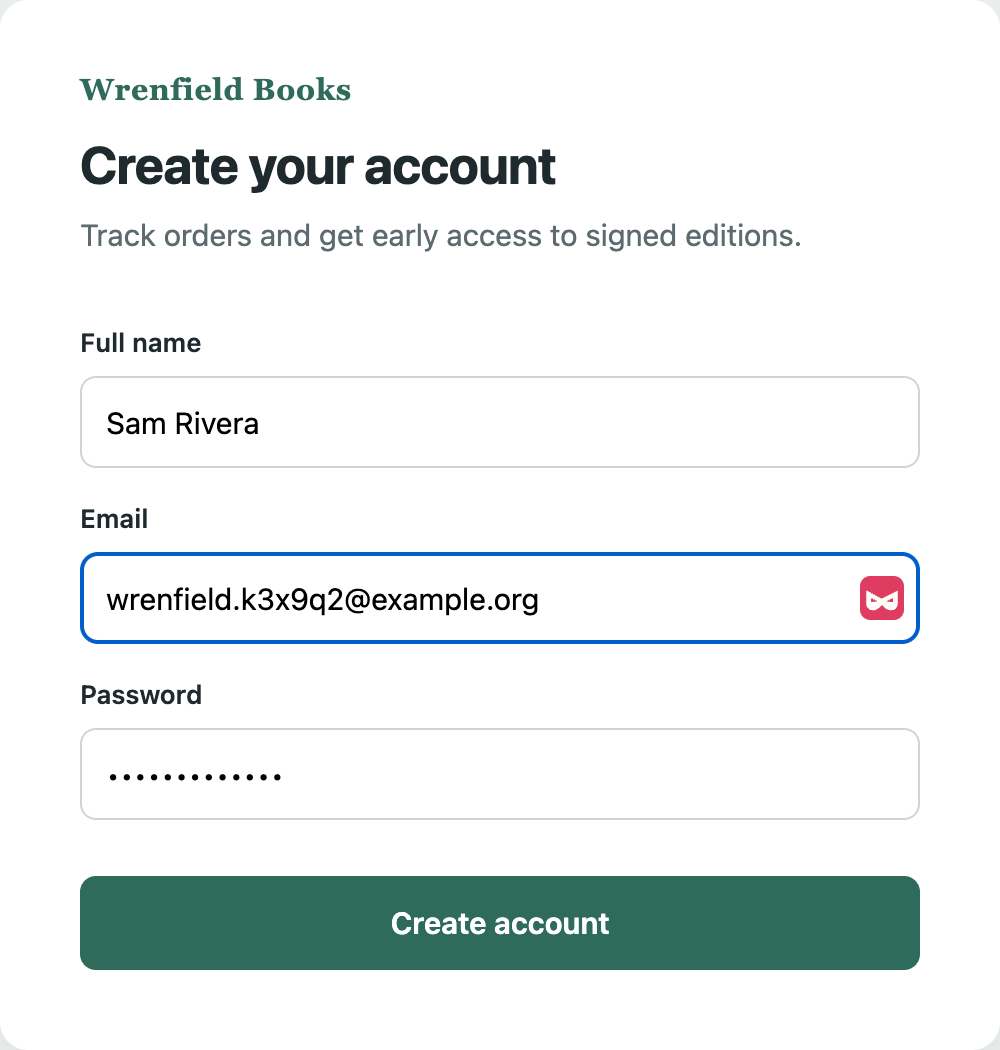
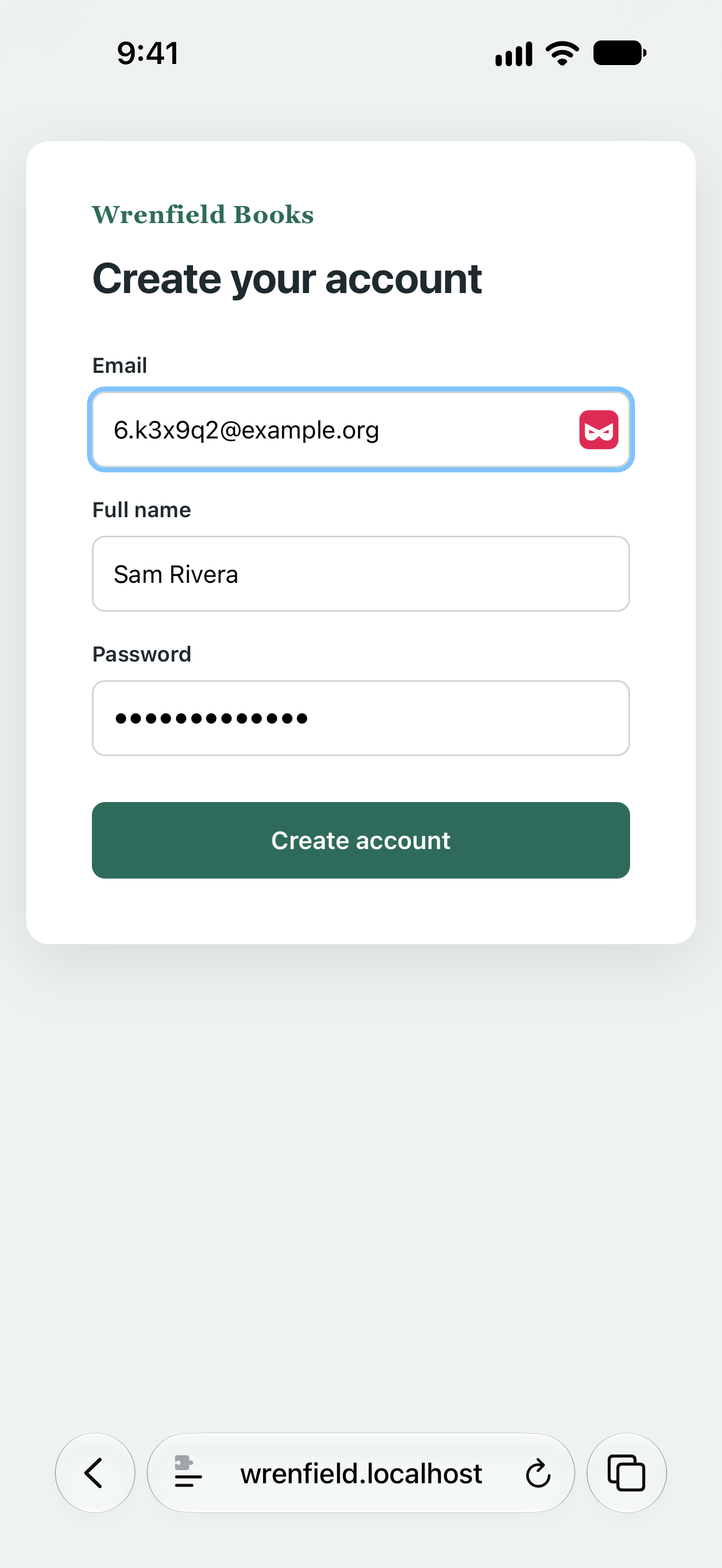
Turn on the autofill button and it appears in email fields on sign-up forms. One click creates a masked address for that site and fills it in.
- Off until you turn it on. Larvatus only asks for permission to access websites if you want the button.
- Named your way. Follows your settings to start addresses with a random character, the site's name, or your own prefix.
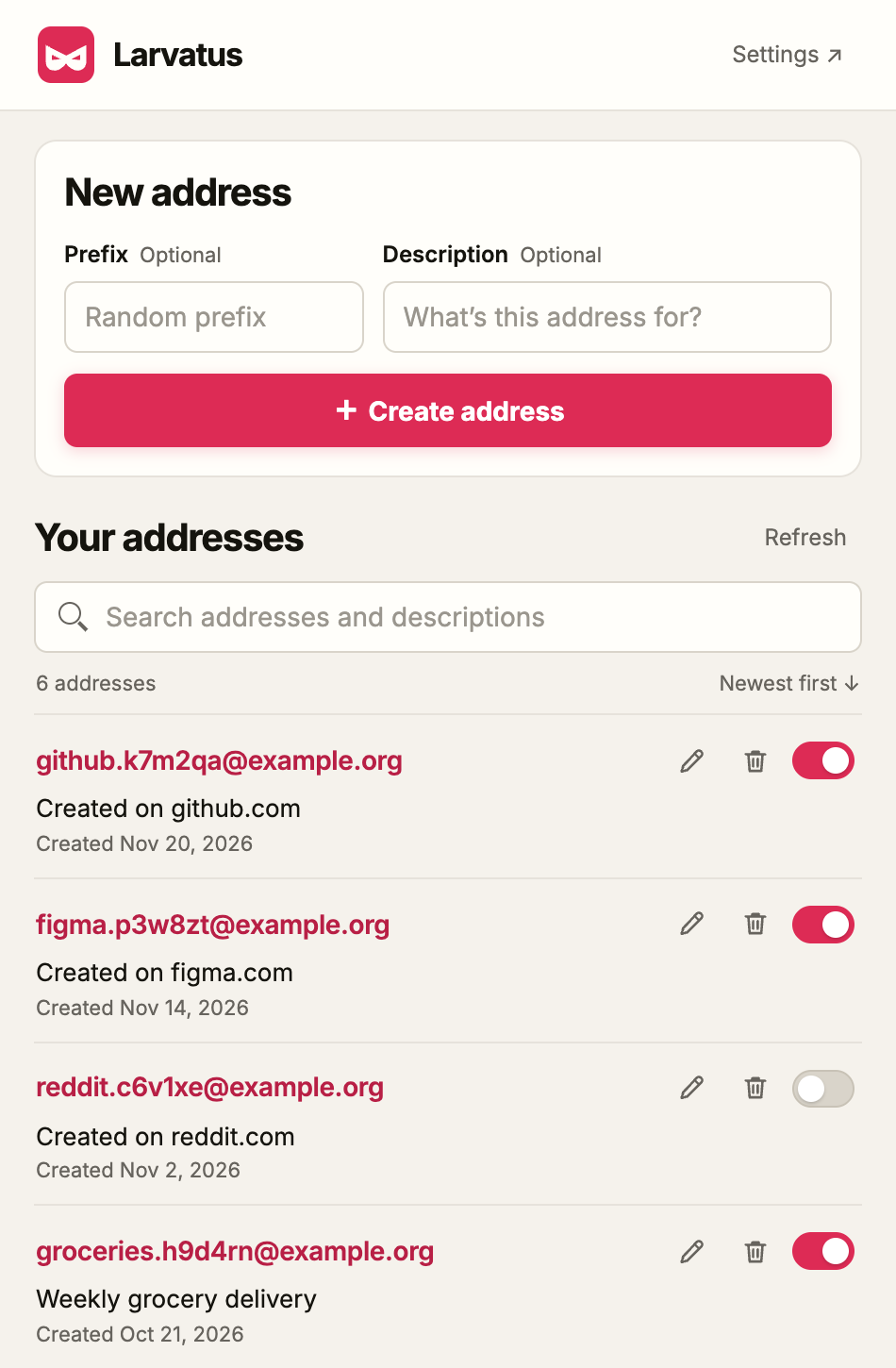
Too much mail? Switch it off.
Every address you've made, newest first, with a note of what it's for.
- Search by address or description.
- Copy an address with a click.
- Switch off delivery, and on again when you want it back.
- Delete an address you'll never need again.
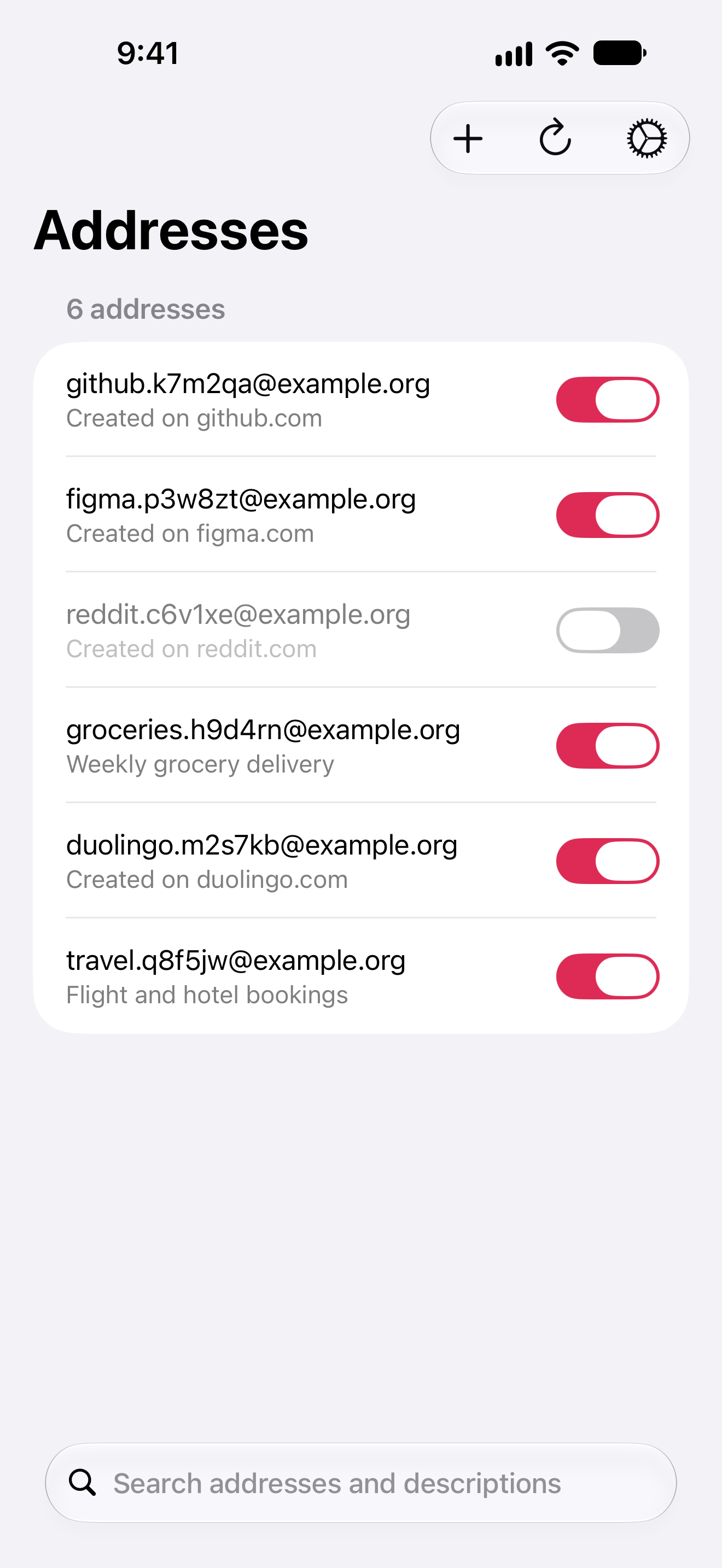
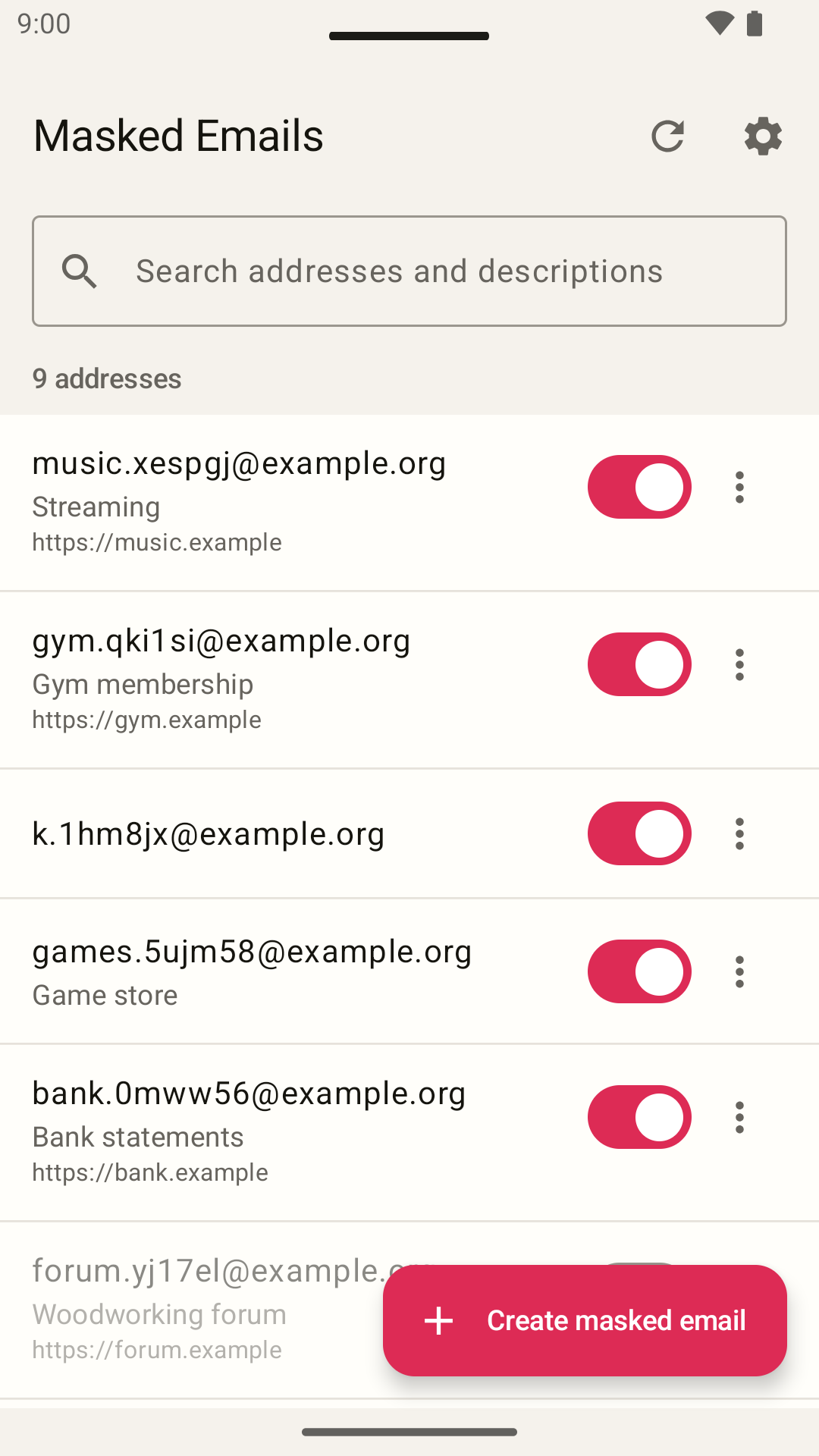
The same addresses, wherever you are.
With the apps for iPhone, iPad, and Android, you can list, search, create, switch off, and delete your addresses.
- Tap an address to copy it.
- Switch delivery off and on from the list.
- Ready when you open it. The app keeps a copy of your list on your device, so it shows up right away.
Fill it in, in any app.
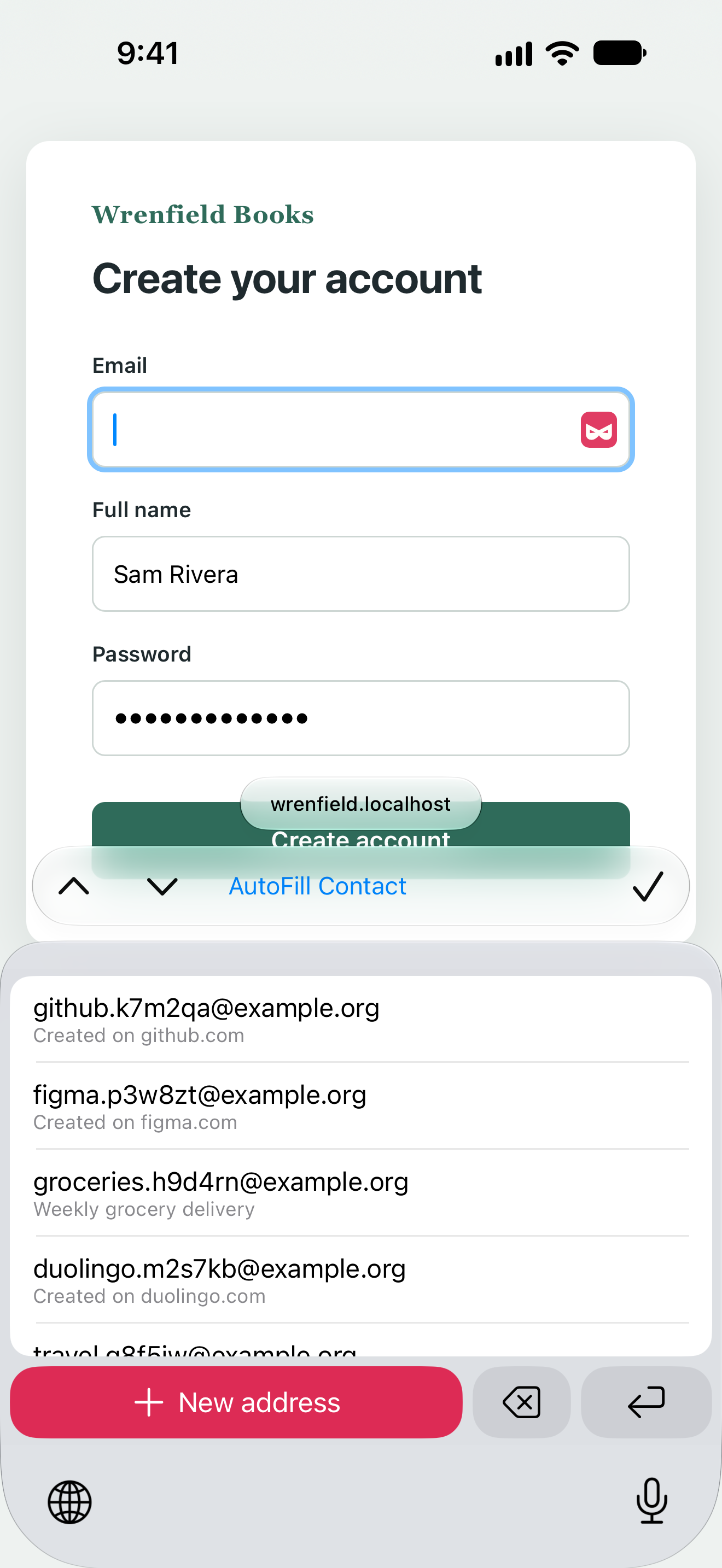
Larvatus can put an address straight into the field you're filling in, three different ways. Turn on whichever you want (the app's Setup screen shows you how).
- AutoFill in any text field: pick an address or create one, and Larvatus inserts it.
- Safari extension with the same button on sign-up forms.
- Keyboard for apps where AutoFill doesn't appear: tap an address to type it.
Your real address stays private.
Private by design
Your addresses, their descriptions, and your sign-in go to your mail server and nowhere else. We never receive them.
No analytics, ads, or tracking
There's nothing in Larvatus to track you with. It doesn't read or send the contents of the pages you visit.
Sign in on your server
You sign in on your server's own page, and Larvatus asks only for access to your account settings, where Stalwart keeps masked addresses.
Get Larvatus.
Chrome
A toolbar popup, and an optional button on sign-up email fields. Also works in other Chromium browsers.
Chrome Web StoreFirefox
A toolbar popup, and an optional button on sign-up email fields.
Pending store reviewiOS and macOS
An app and a Safari extension for iPhone, iPad, and Mac. iPhone and iPad also get AutoFill in any text field, and a custom keyboard for everything else.
Pending store reviewAndroid
An app that lists, searches, creates, copies, switches off, and deletes your addresses.
Coming soonWhat you need
An account on a Stalwart mail server running version 1.0.3 or later. The server must be reachable over HTTPS and have its sign-in (OAuth) server, public client registration, and masked addresses turned on.
The server can be your own or one a provider runs for you. Its administrator sets how many masked addresses you can have. The guide for administrators covers the Stalwart settings.
Frequently asked questions
What is a masked address?
A separate email address you give to one site in place of your real address that delivers to your real inbox. If that site sends too much, or the address ends up with someone you never gave it to, you switch off that one address and nothing else changes.
Do I need my own mail server?
You need an account on a Stalwart mail server, version 1.0.3 or later. You can run it yourself or use a provider that runs Stalwart. Larvatus isn't a mail service and has no servers of its own. Masked addresses are a Stalwart feature, and Larvatus is the quick way to use them.
What happens to mail sent to an address that is switched off?
Your server rejects it. Switch the address back on and delivery resumes. If you delete an address instead of disabling it mail sent to it is no longer delivered, and you can never get that address back.
How many addresses can I have?
Your server's administrator decides, but Stalwart's default is very small and we recommend increasing it. When you reach the limit, Larvatus shows your server's message, and you can delete an address you no longer need to make room.
What can Larvatus see?
Not your password: you sign in on your server's own page. Larvatus asks your server only for access to your account settings, which is where Stalwart keeps masked addresses. What it handles stays on your device or goes to your server. The privacy policy has the details.
What does Larvatus mean?
Larvatus is Latin for masked or disguised. You may know it from René Descartes' famous motto Larvatus prodeo, "I go forth masked."
Is Larvatus made by Stalwart?
No. Larvatus isn't affiliated with or endorsed by Stalwart Labs. Stalwart is just the free and open-source mail server it currently works with.
Larvatus is developed by Triplebit Corporation, a Delaware 501(c)(3) public charity which has developed this decentralized/self-hosted tool to further its mission of promoting safe online privacy practices and providing digital privacy education to the public.
Who is Triplebit?
Triplebit Corporation (AKA Triplebit) is a Delaware 501(c)(3) public charity which has developed this decentralized/self-hosted tool to further its mission of promoting safe online privacy practices and providing digital privacy education to the public.
Triplebit's charitable mission is to defend our First and Fourth Amendment rights in the United States by operating privacy-focused public benefit infrastructure, educating people on digital and financial privacy, promoting free, uncensored internet access for journalists and activists in the United States and globally, and contributing to scientific research in digital privacy fields.
Triplebit is entirely donor-funded and operates with virtually no administrative overhead. If you are a supporter of self-hosted tools, privacy by design, and digital rights please consider making a donation to support our charitable mission. As a public charity, your donation in the United States may be tax-deductible, but Triplebit Corporation does not provide any accounting or legal advice.
Support Triplebit
Larvatus is free. If you find it useful, please consider a donation to Triplebit, a nonprofit 501(c)(3) public charity working on digital rights and technology for the public good.
Larvatus prodeo.